Unit 4 - Food preparation
4.2. Tools to modify the thickness of liquids and the texture of solid foods
4.2.2.1. Empirical and imitative methods
Those methods include IDDSI Methods and some others used in different fields of food science.
IDSSI Methods
-
The IDDSI Flow test
This method uses a 10 mL slip tip hypodermic syringe.
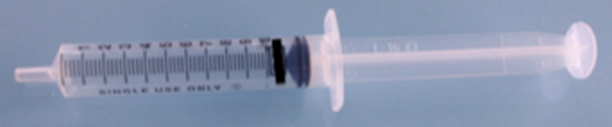
Instructions:
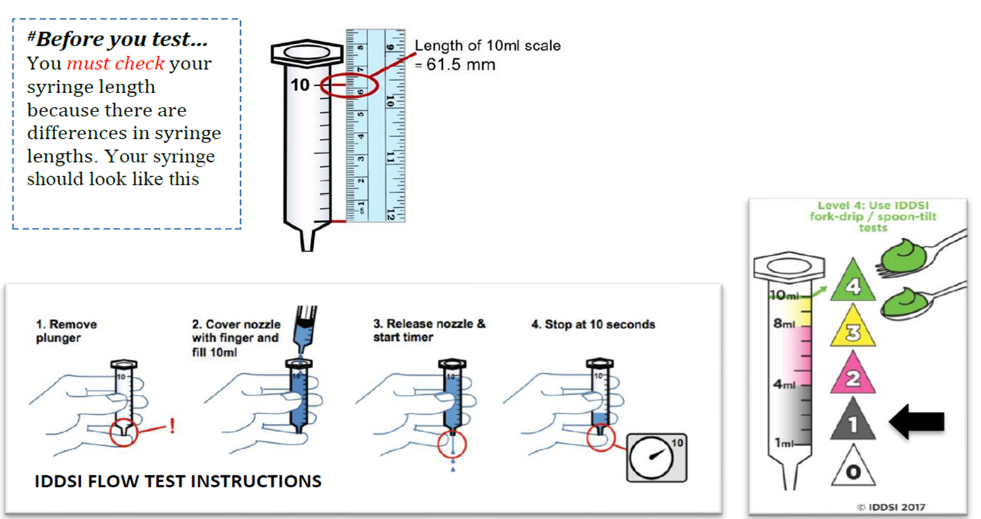
(see IDDSI Flow Test instructions*):
https://www.youtube.com/watch?v=--KHFRql39M
 Testing
tips for IDDSI Flow Test:
Testing
tips for IDDSI Flow Test:
• When using commercial thickener products, follow the manufacturer’s instructions and mix thoroughly, watching closely that there are no lumps or air bubbles present. Be sure to allow the recommended time for the fluid to thicken completely.
• Use a clean, dry syringe of the correct type each time you test.
• Check the nozzle of the syringe is completely clear and free from any plastic residue or manufacturing defects that may occasionally occur.
• Test twice or more to ensure more reliable results.
• Check for lumps – especially if flow suddenly stops. In this case the fluid may not be suitable for dysphagia use.
• Ensure to test the liquid at the intended serving temperature
-
IDDSI Fork/Spoon Drip Test
Food may be tested by assessing whether they flow through the tines/prongs of a fork or not.
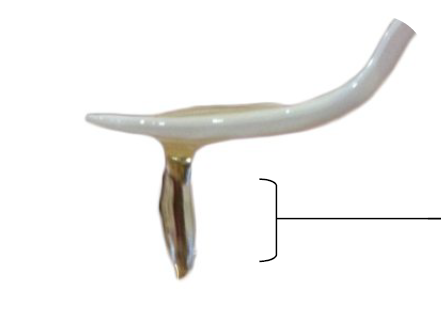
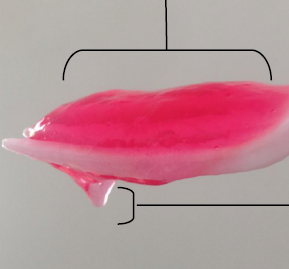
(Source: https://www.iddsi.org)
The spoon tilt test is used to determine the stickiness of the sample (adhesiveness) and the ability of the sample to hold together (cohesiveness).
Testing
tips:

• The sample should be cohesive enough to hold its shape on the spoon.
• A full spoonful must plop off the spoon if the spoon is tilted or turned sideways; a very gentle flick (using only fingers and wrist) may be necessary to dislodge the sample from the spoon, but the sample should slide off easily with very little food left on the spoon. A thin film remaining on the spoon after the Spoon Tilt Test is acceptable, however, you should still be able to see the spoon through the thin film; i.e. the sample should not be firm and sticky.
• A scooped mound may spread or slump very slightly on a plate.
Other empirical o imitative methods
|
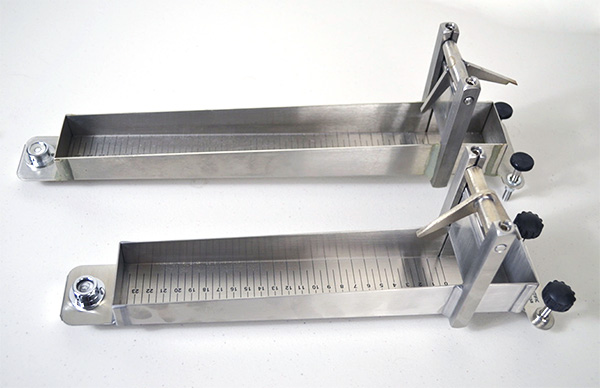
The Bostwick Consistometer is a simple device for measuring consistency and flow rate in a variety of products. It can be used on any viscous material such as sauces, salad dressings, paints, chemicals or cosmetics. The normal way to use the Consistometer is to measure the distance a sample flows in a given time interval. The
"Bostwick" is a trough with 0.5 cm gradations along the
bottom. The trough is separated near one end by a spring-loaded
gate. This forms a chamber where the sample is loaded. |
(Source: https://www.cscscientific.com) |
|
Line-spread test (LST). Some results of the current study suggest that the LST may be useful in the broad categorization of fluids into therapeutically significant groupings but that it cannot be used more specifically to measure fluid viscosity. Some other results suggest that the LST is a more reliable method than the IDDSI test for evaluating the correct and desirable viscosity for the dysphagia diet, and that the IDDSI test provides a means to predict the rheometer-measured viscosity of water thickened with only XG-based thickeners (Kim et al., 2018) |
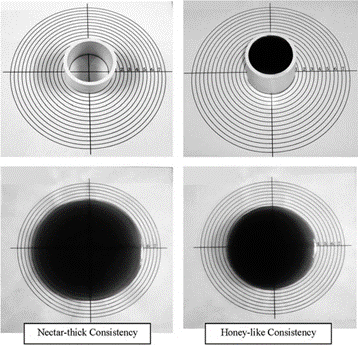
(Source: Kim et al., 2018) |
|
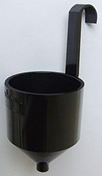
Ford Cup - it is a simple device, based on gravity, used to measure the viscosity of fluids. It measures the time of a known volume of a fluid passing through an orifice located at the bottom. It is not commonly used for dysphagia preparations.
|
(Source: https://www.nonpaints.com) |
Fundamental methods for the measurement of rheological properties
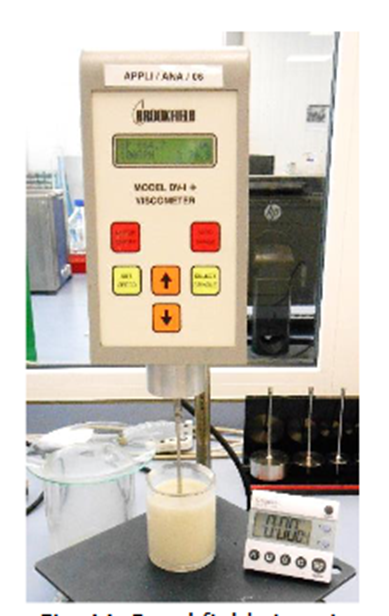
Fundamental tests are based on the measurement of physical properties of the food.
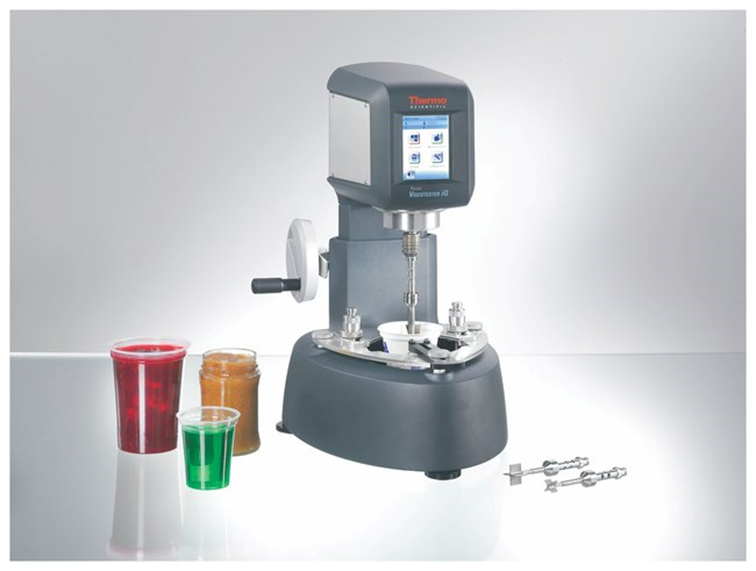
For optimal design of food and liquid adapted for dysphagia, it is necessary to know not only the viscosity of the products, but also the bolus viscoelasticity, yield stress, extensional viscosity, mechanical properties and lubrication properties of food. They can be obtained using fundamental testing methods.
They are commonly used at a laboratory scale for the design of thickening agents and pre-packaged ready-to-use thickened products.
 |
 |
|---|---|
| Viscosimeter | Rheometer |
(Source: https://assets.thermofisher.com)
Texture
analyzers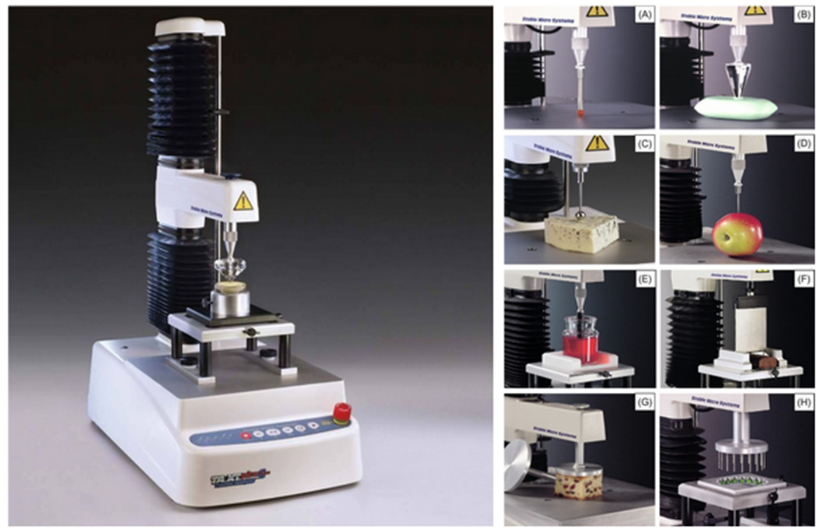
Texture analyzers are also used to measure the rheological and textural properties of semi-solid food.
Both fundamental and imitative tests can be implemented.
The equipment is expensive, but several probes are available for different types of food.
It has been proposed that a texture analyzer would be optimal for the evaluation of the texture of solid or gel-type food used in dysphagia.
https://www.stablemicrosystems.com/TAXTplus.htm
Tribology
Nowadays, the study of the interaction of food with saliva during mouth manipulation and swallowing is being studied applying food tribology.
-
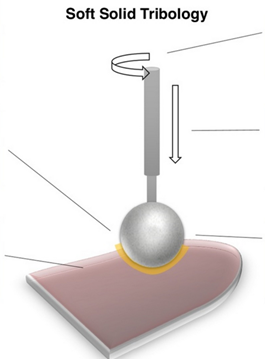
Tribology describes friction, lubrication and wear between two interacting surfaces.
-
Soft tribology refers to the study of the interaction between food and surfaces within the oral cavity during food consumption.
-
It is an interesting approach for understanding oral processing and sensory perception of foods.
-
It can be useful to study the behavior of food when xerostomia appears, a common problem developed by geriatric population and by other patients.
-
The study of lubrication properties of different thickened liquids, shows differences between thickeners. Modified starch thickeners showed a lower lubricant capacity than that of gum-based ones.
-
Inclusion of tribological parameters into the IDDSI scale would be of interest (Rudge et al., 2019).