Unit 4 - Food preparation
4.5. Hygiene and food safety in dysphagia
4.5.4 Correct food hygiene
Personal hygiene in Food handlers
All food handlers must be aware that high standards of personal hygiene are important.
Some rules for food workers are the following:
Food handlers must wear clean outer clothing and hair and beard restraints (hats, hairnets)
Food handlers should keep their fingernails short and not wear any jewelry on their arms and hands.
Food handlers should use gloves of food handling utensils or papers to handle ready-to eat-food.
Food handlers should use hands-fee taps and paper towel dispensers to reduce the risk of contamination
Food handlers must wash their hands frequently using soap and water and paper towels to dry.
Food handlers should cover any wounds, cuts or open bruises on their hands or arms with a waterproof bandage.
Food handlers who feel ill with symptoms such as vomiting, diarrhea, sore throat or fever must report to their manager or supervisor.
Employees should be trained in proper food-handling and sanitation practices and they must in a healthy state and be free from infections.
Safe food handling
These are “Five keys to safer food”, which were developed by WHO to educate safe food handling behaviors to all consumers and food handlers:
Keep clean
Separate raw and cooked
Cook thoroughly
Keep food at safe temperatures
Use safe water and raw materials
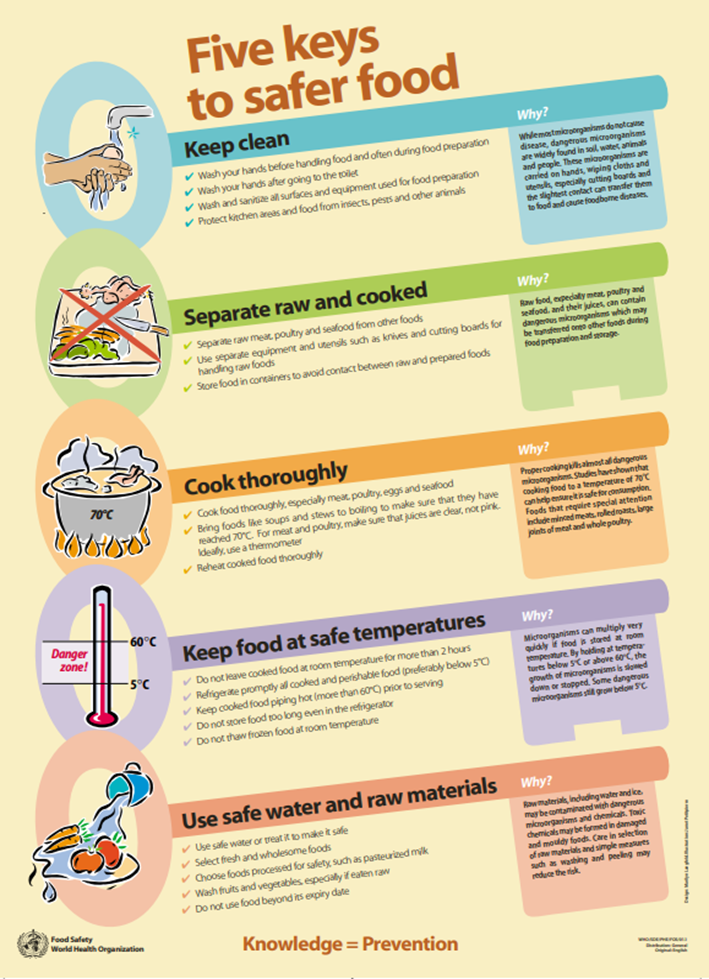
(Source: WHO, 2021)
Storing food
Food storage should be aimed to keeping nutritional, sensory and hygienic quality.
The procedures have to:
Prevent or delay microbiological activity
Prevent or delay enzymatic activity and chemical reactions
Prevent contamination from other agents.
You must carefully follow storage instructions.
A use-by date on food is about safety. This is the most important date to remember. You can eat food until and on the use-by date but not after. You will see use-by dates on food that goes off quickly, such as meat products or ready-to-eat salads.
For the use-by date to be a valid guide, you must carefully follow storage instructions. For example, if the instructions on the packaging tell you to refrigerate after opening, you should keep the food in a fridge at 5°C or below. Find out more about chilling your food correctly.
After the use-by date, don't eat, cook or freeze your food. The food could be unsafe to eat or drink, even if it has been stored correctly and looks and smells fine., including meat and milk, can be frozen before the use-by date though so plan ahead.
The best before date, sometimes shown as BBE (best before end), is about quality and not safety. The food will be safe to eat after this date but may not be at its best. Its flavour and texture might not be as good. Best before dates appear on a wide range of foods including frozen foods, dried foods and tinned foods.
The best before date will only be accurate if the food is stored according to the instructions on the packaging.
Chilling food
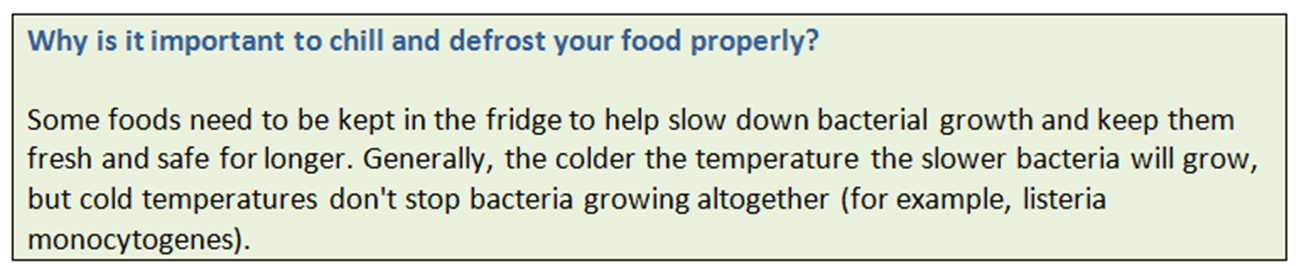
Chilling food properly helps stop harmful bacteria from growing.
To keep your food safe:
store any food with a 'use by' date, along with cooked dishes, salads and dairy products, in your fridge
keep chilled food out of the fridge for the shortest time possible during preparation
cool cooked food quickly at room temperature and then place in the fridge within one to two hours
You need to check that your fridge is cold
enough using a fridge thermometer. This is because the dials on
fridges don't always show you the right temperature. Your fridge
should be 5°C or below.
Don't overfill your fridge. Leaving space allows air to circulate and maintains the set temperature.
Video:
https://www.youtube.com/watch?v=6dBZq-RskPg&list=PLkq7R7IpXHhU8fZRxHKRKgM26q8Fh6eXQ&index=4
Freezing food
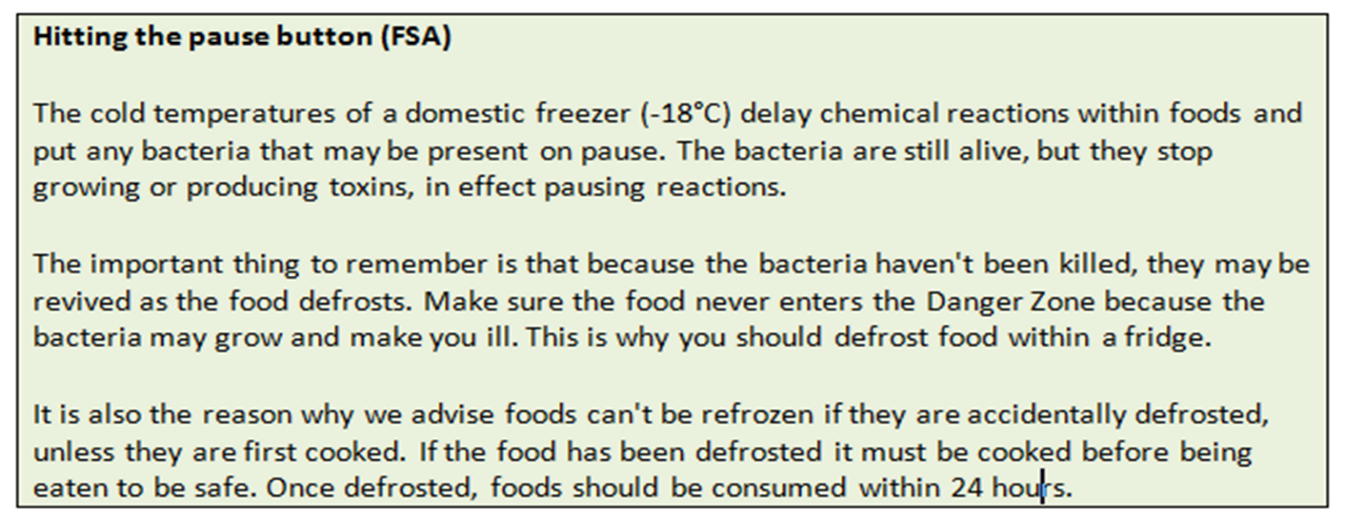
A freezer acts as a pause button - food in a freezer won't deteriorate and most bacteria cannot grow in it.
You can freeze pre-packaged food right up to the 'use by' date.
Leftovers and homemade goods should be frozen as soon as possible.
Make sure any warm dishes are cooled before putting them in your freezer.
To stop the cold air in your freezer from drying out your food you can:
place food in an air-tight container
wrap it well in freezer bags or freezer wrap
It doesn't matter if you cook your meat from frozen or fresh, you can use your leftovers to make a new meal.
Check packet instructions to ensure that foods are suitable for freezing, especially for Ready-To-Eat foods.
Defrosting your food
When you take your food out of the freezer, it's important to defrost it safely before cooking or eating it.
Don't defrost food at room temperature. Ideally, food should be defrosted fully in the fridge. If this isn't possible, use a microwave on the defrost setting directly before cooking. Check the guidance on food packaging and allow enough time for your food to defrost properly. Large items, can take up a long time to defrost fully in the fridge.
Make sure your food is fully defrosted before cooking. Partially defrosted food may not cook evenly, meaning that harmful bacteria could survive the cooking process. Once food has been defrosted, eat it within 24 hours.
The 'Danger Zone'
Most harmful bacteria will grow at temperatures above 8°C and below 63°C – this is known as the ‘Danger Zone’ for microbial growth. That’s why we advise that the safest way to defrost food is in the fridge overnight. By defrosting in the fridge, your food should never enter the ‘Danger Zone’. Your fridge should be 5°C or below, as some bacteria can grow at lower temperatures than 8°C.

Avoid cross-contamination
Cross-contamination is the transfer of harmful bacteria to food from other foods, cutting boards, and utensils if they are not handled properly.
This is especially true when handling raw meat, poultry, eggs, and seafood, so keep these foods and their juices away from already cooked or ready-to-eat foods and fresh product.
To avoid cross-contamination:
Keep apart raw meat, poultry, fish and shellfish from other foodstuffs when purchasing preparing and storing food.
Always use a clean cutting board. Wash cutting boards, dishes, and counter tops with hot, soapy water after preparing each food item and before you go on to the next item.
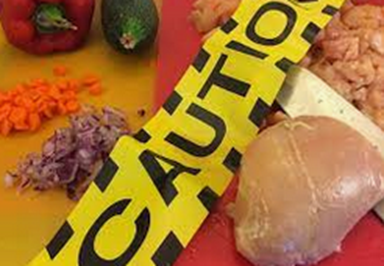
If possible, use one cutting board for fresh produce and a separate one for raw meat, poultry, and seafood.
Once cutting boards become excessively worn or develop hard-to-clean grooves, you should replace them.
Wash hand with hot, soapy water after preparing each food item and before you go on to the next item
(Source: https://www.istockphoto.com)
Food labelling
Food labelling must ensure all the mandatory
information to the consumers. Should reflect quantity, list of
ingredients, nutrition information, instructions to storage or to
use, shelf-llife, and presentation of allergens (e.g. soy, nuts,
gluten, and lactose)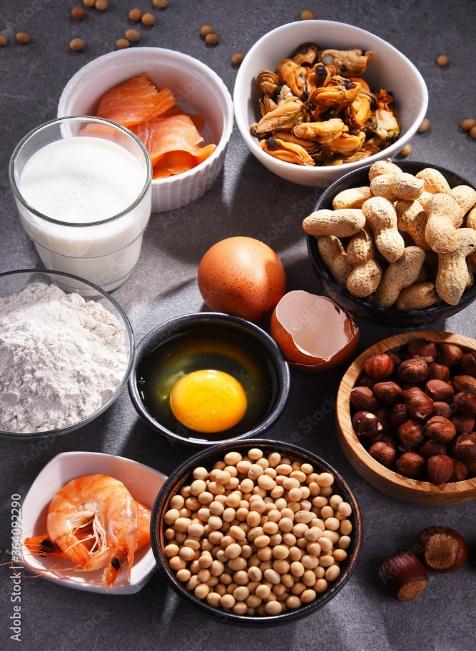
Allergens
When working with commercially available dysphagia adapted products is necessary to consider the following aspects:
Those products do not contain usually lactose or gluten, but it is necessary to confirm and check technical sheets.
Some products may content dairy products, egg, fish, selfish, legumes, chocolate.
Those aspects should be taken into account when working with users suffering food intolerances and/or food allergies.
(Source: https://stock.adobe.com)
Control and monitoring of food safety
The HACCP is a process or system for control of food safety in food service in health institutions.
HACCP stands for Hazard Analysis and Critical Control Point.
These hazards or critical situations may result from pathogenic microorganisms; chemical residue; physical objects; employees; or adulteration or cross-contamination at any point during the distribution, storage, or preparation system.
The seven principles of HACCP are: Identify hazards, determine Critical Control Points (CCP), set up critical limits, monitor CCP, take corrective actions, verify and keep records.
CCP refers to any point where action must be taken to eliminate the hazard.
The process can be used to control any point in the food production process or system where a hazard or critical situation may occur.
These hazards or critical situations may result from pathogenic microorganisms; chemical residue; physical objects; employees; or adulteration or cross-contamination at any point during the distribution, storage, or preparation system.
In food service management, HACCP focuses on the flow of food through the operation, beginning with the decision of what foods to include on the menu and continuing with recipe development, food procurement, delivery and storage, preparation, holding or displaying, service, cooling, storage, and reheating.
In food service management, HACCP focuses on the flow of food through the operation, beginning with the decision of what foods to include on the menu and continuing with recipe development, food procurement, delivery and storage, preparation, holding or displaying, service, cooling, storage, and reheating.
Depending on the system used in the food service operation, the HACCP process would differ
A conventional food service system receive, prepare, cook, hold, and serve would entail the largest number of CCPs.
CCPs need to be developed for each step.
Correct temperatures for both hot and cold systems must be constantly monitored. Some bacteria will continue to grow and reproduce if safe temperatures are not maintained.