Unit 4 - Food preparation
4.4. Texture‐modified foods preparation techniques and equipment
4.4.1. Texture-modified foods
-
Texture-modified foods are culinary preparations that modify the characteristics of foods in order to make them safe, effective, nutritious and organoleptically and visually appealing to people with chewing and swallowing problems.
-
They must meet five characteristics: safety, efficacy, nutritious, organoleptically adequate and attractive presentation.
-
The texture modified food should be as similar as possible to the original preparation.
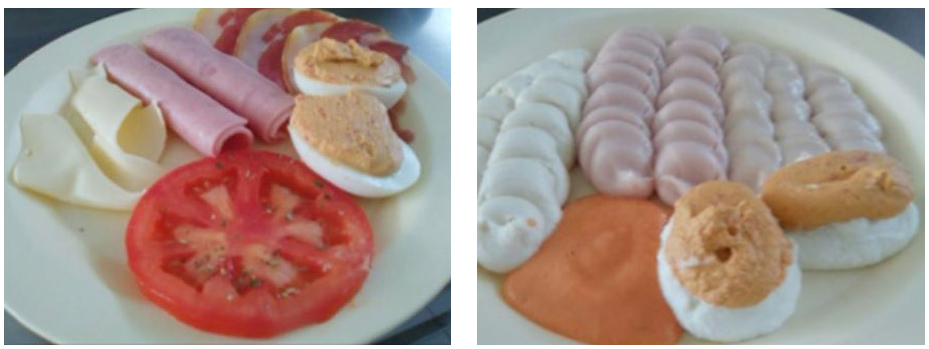
Fig 1. Texture modified food (right) and conventional food (left). Source: CADIS- ASPACE (Huesca)
Stages for preparation of texture modified foods
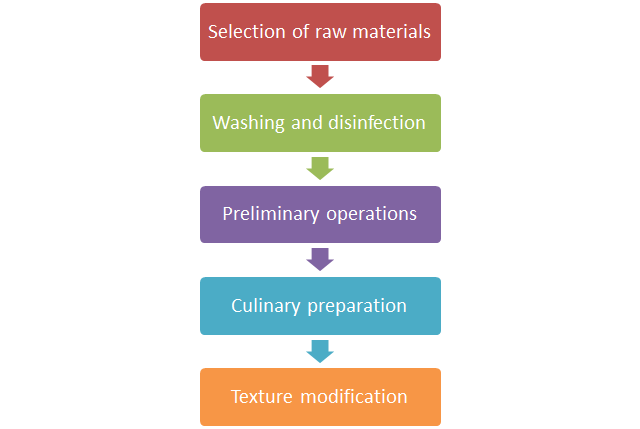
It is necessary to establish protocols for the elaboration and adaptation of the texture of the different dishes. There is no standardized protocol, but the following stages are recommended:

-
Selection of raw ingredients
Foods present a series of characteristics that determine their nutritional composition and behavior during culinary processes.
Foods should be chosen as fresh as possible and in an optimal state of maturation.
Selection of certain portions or cuts from food avoiding dangerous, hard or undesirable parts in meats, vegetables, fruits and legumes.
Selection of foods and parts with high nutritional value (Review Unit 3.1. for more information about nutrition and nutritive values of different ingredients).
-
Washing and disinfection
This stage is especially important in the case of foods that are not going to be subjected to heat treatment.
See Unit 4.5. for more information about Food hygiene.
-
Handling _ Preliminary operations
Cleaning and sorting
Elimination of inedible or dangerous parts and selection of those to be subjected to further culinary processing.
Cutting
Reduction of the size of the food, which will condition the cooking conditions and the interactions of the food with the heating medium.
-
Culinary preparation
Culinary techniques are procedures that involve heat treatment or other types of treatment, which allow their characteristics to be modified. It determines the texture of the food, but also the flavor, color, aroma and nutritional value.
Different techniques can be applied such as baking, braising, frying, sautéing or grilling, which can favor the appearance of crusts on the surface.
Stews, confit, steaming, papillote or vacuum cooking maintain the flavor and give rise to soft and smooth textures.
Boiling and poaching diminish flavor and aroma, but result in soft and tender textures.
-
Texture modification
The reduction of the particle size of the elaborations is necessary when the characteristics obtained after the application of the culinary technique are not adequate to guarantee the safety and efficacy of the swallowing process.
The use of professional machines with high chopping and mixing power may be necessary.
During this process, the following aspects should be controlled:
- If addition of liquids is needed
- If addition of thickeners is needed
-Minimize the modification of the nutritive value, avoiding dilutions or increases in caloric density.
- Minimize the loss of organoleptic characteristics.
Refrigeration and cold storage
Temperature should be lowered using a blast chiller or cooler unit.
Cold storage should be at 5ºC.
Reheating
Microwaves, stem ovens or ovens may be used to reheat the food.