Unit 4 - Food preparation
4.3. Levels, descriptors and measurement methods in dysphagia oriented products
4.3.1. Levels, descriptors and methods for liquid food

Description/Characteristics
-
Flows like water
-
Fast flow
-
Can drink through any type of teat/nipple, cup or straw as appropriate for age and skills.
Physiological rationale for this level of thickness
-
Functional ability to safely manage liquids of all types
Testing method
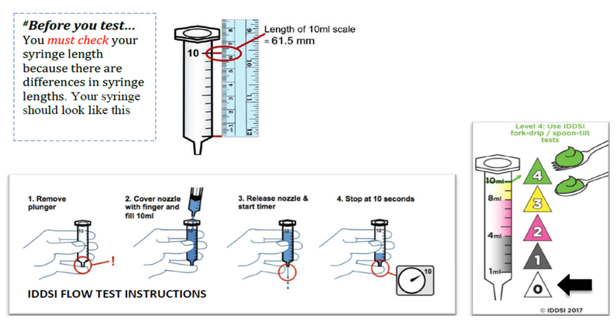
IDDSI Flow Test: Less than 1 mL remaining in the 10 mL slip tip syringe after 10 seconds of flow
(Source: https://www.iddsi.org)

Description/Characteristics
-
Thicker than water
-
Requires a little more effort to drink than thin liquids
-
Flows through a straw, syringe, teat/nipple
-
Similar to the thickness of most commercially available ‘Anti-regurgitation’ (AR) infant formulas
Physiological rationale for this level of thickness
-
Often used in the pediatric population as a thickened drink that reduces speed of flow yet is still able to flow through an infant teat/nipple. Consideration to flow through a teat/nipple should be determined on a case-by-case basis.
-
Also used in adult populations where thin drinks flow too fast to be controlled safely. These slightly thick liquids will flow at a slightly slower rate.
Testing method
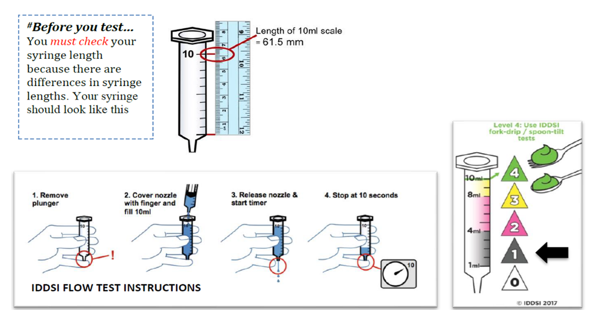
IDDSI Flow Test: Test liquid flows through a 10 mL slip tip syringe# leaving 1-4 mL in the syringe after 10 seconds
(Source: https://www.iddsi.org)

Description/Characteristics
-
Flows off a spoon
-
Shippable, pours quickly from a spoon, but slower than thin drinks
-
Mild effort is required to drink this thickness through standard bore straw (standard bore straw = 0.209 inch or 5.3 mm diameter)
Physiological rationale for this level of thickness
-
If thin drinks flow too fast to be controlled safely, these Mildly Thick liquids will flow at a slightly slower rate
-
May be suitable if tongue control is slightly reduced.
Testing method
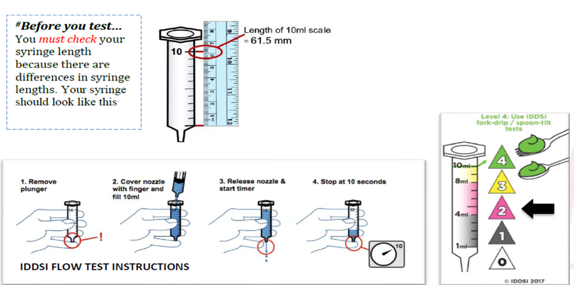
IDDSI Flow Test: Test liquid flows through a 10 mL slip tip syringe leaving 4 to 8 mL in the syringe after 10 seconds
(Source: https://www.iddsi.org)


Description/Characteristics
-
Can be drunk from a cup
-
Moderate effort is required to suck through a standard bore or wide bore straw (wide bore straw = 0.275 inch or 6.9 mm)
-
Cannot be piped, layered or molded on a plate because it will not retain its shape
-
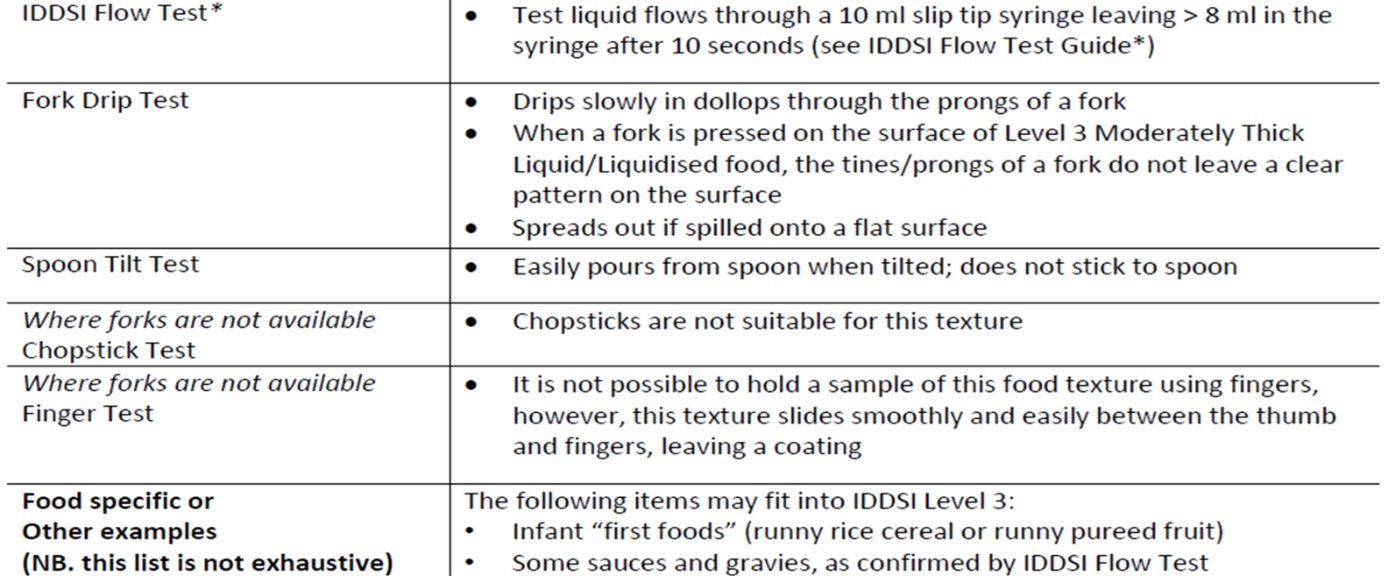
Cannot be eaten with a fork because it drips slowly in dollops through the prongs
-
Can be eaten with a spoon
-
No oral processing or chewing required – can be swallowed directly
-
Smooth texture with no ‘bits’ (lumps, fibers, bits of shell or skin, husk, particles of gristle or bone)
Physiological rationale for this level of thickness
-
If tongue control is insufficient to manage Mildly Thick drinks (Level 2), this Liquidized/Moderately thick level may be suitable
-
Allows more time for oral control
-
Needs some tongue propulsion effort
-
Pain on swallowing
Testing method
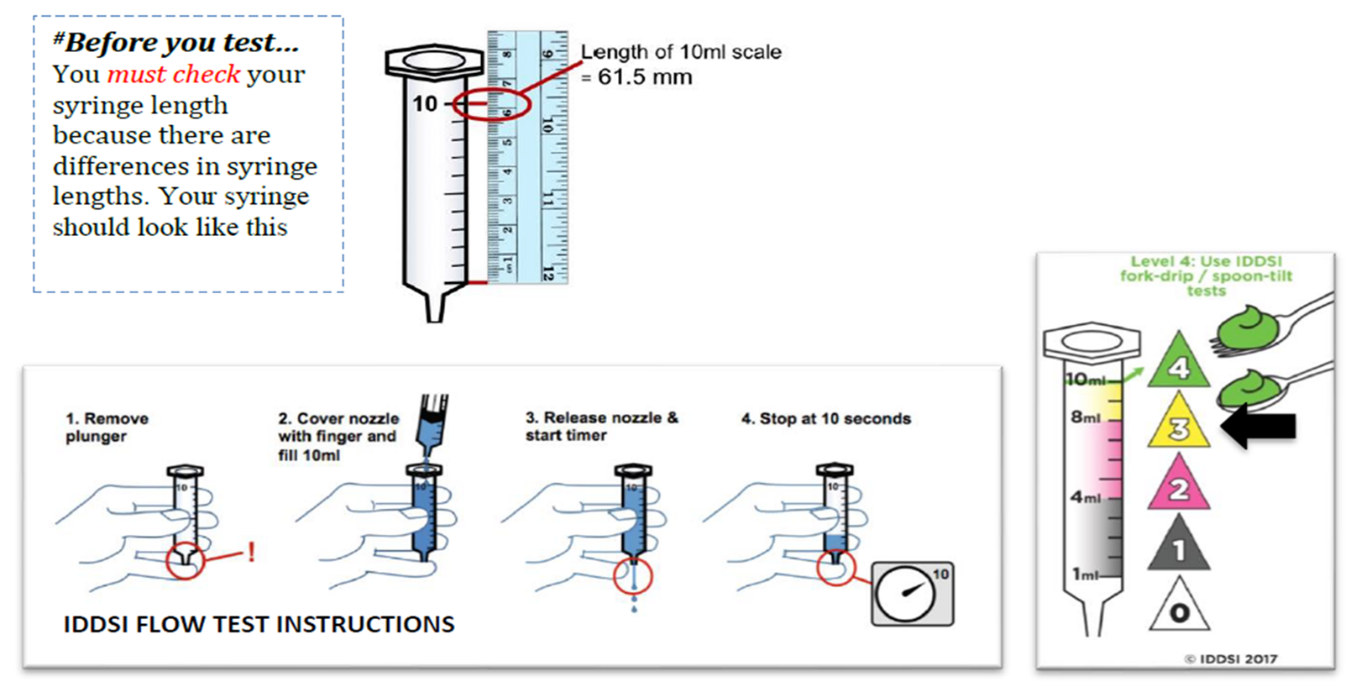
(Source: https://www.iddsi.org)
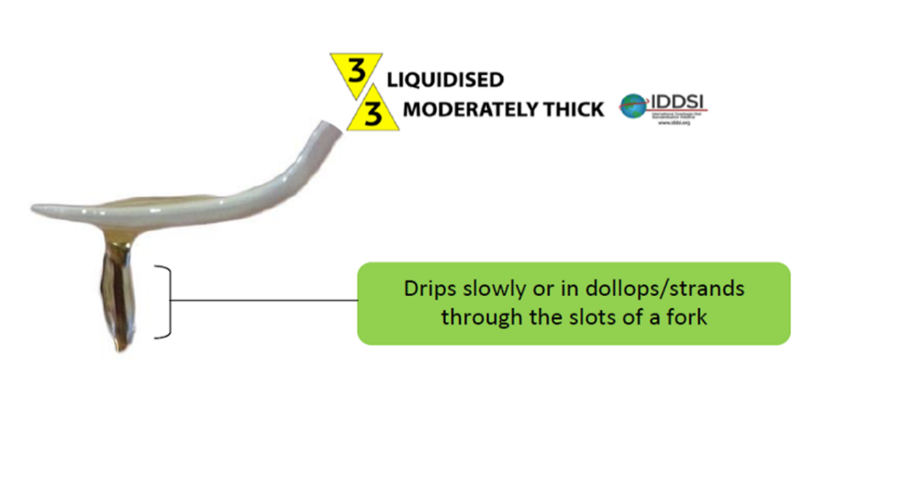
Fork Drip Test
(Source: https://www.iddsi.org)