Unit 4 - Food preparation
4.2. Tools to modify the thickness of liquids and the texture of solid foods
4.2.1. Rheological and textural properties in dysphagia management
-
Specially made and nutritional enriched texture modified foods and thickened fluid has been implemented over the last years for dysphagia management.
-
Ensuring that thickened fluids have suitable flow properties is an essential part of dysphagia management to ensure safe swallowing. Fluids that are too thin may be aspirated, potentially causing pneumonia, while over-thickened fluids may become a choking risk due to residue.
-
Nevertheless the food and beverages used in dysphagia management are usually described qualitatively (e.g. hard, moisture-food, sticky, thin, thick, etc.) and it is still difficult and subjective to categorize the food for patients and caregivers.
-
Many clinicians and researchers agree the terms thick or thin seem not to be enough to ensure the safety of the preparations. Thickened liquids and modified food used for dysphagia management need to be characterized and described more in detail in terms of their rheological properties.
Flow and textural properties of food in dysphagia management
-
Rheological properties* describe how the foods deform or flow in response to stress. They help to characterize the food behavior in complex deformations, such as those encountered during swallowing.
*Rheology is a branch of physics that studies the deformation and flow of materials.
-
Rheological properties of food and liquids used in dysphagia management are complex and they depend on the type and concentration of the thickening agent, temperature, pH, composition of the fluid or solid foodstuff, time after preparation….
-
It is important that research communities and health professionals, including dietitians, nurses, speech and language therapists, physicians and scientists, can use a common terminology and methodology to be used during texture modification for dysphagia management practices.
Flow properties and dysphagia_ Viscosity
-
Viscosity, which is a term broadly used in dysphagia management, is a measure of the resistance of the materials to flow.
-
The unit of measurement is pascal-seconds (Pa. s) in the International System of Units (SI), but it is also reported in Centipoise (cP), where 1cP=1 mPa. s.
-
Liquids like water do not have much resistance to flow and are, therefore, classified as ‘low viscosity’. It takes little effort to stir water with a spoon. However, liquids like molasses or tomato sauce have slow flow rates and consequently a ‘high viscosity’.
-
Some examples of viscosity values are the following: water at 20℃ has a viscosity of 1.0 mPa.s.; honey has a viscosity of 10,000 mPa.s; and tomato sauce has a viscosity of 50,000 mPa.s.
-
Temperature influences viscosity of fluids.
Flow properties and dysphagia_ Viscosity and related terms
-
In the field of dysphagia, the viscosity of food products is commonly measured with a rheometer at 25 ºC at a shear rate of 50 s-1.
-
Common levels of liquid thickness used in dysphagia management in different countries are the following:
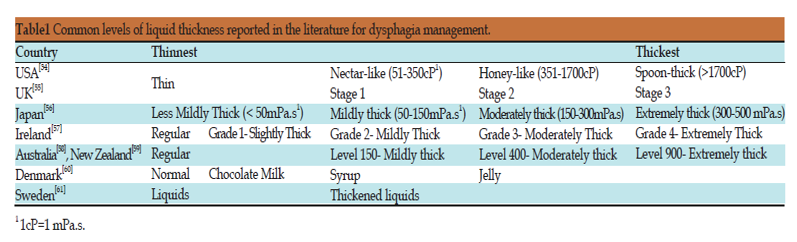
(Source: Cichero and Lam, 2014)
Flow properties and dysphagia_ Viscosity, related terms and levels
The National Dysphagia Diet Task Force defines viscosity in standardized viscosity measurements in centipoise (cP) at a shear rate (s-1) of 50 s-1.
The International Dysphagia Diet Standardization Initiative (IDDSI) utilizes flow rate as an indicator for liquid level; the scale of 0–4 is determined by the amount of liquid remaining in a 10 mL syringe following a free flow period of 10 s.
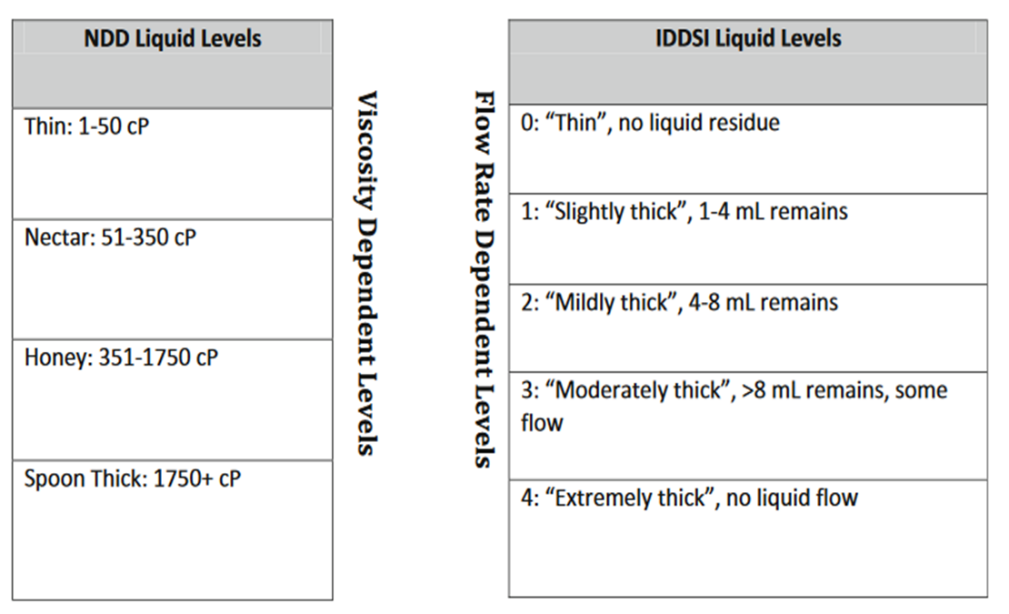
Source: Cichero and Lam, (2014).
Other meaningful flow properties in dysphagia management
Whilst
the viscosity of a liquid provides us with useful information, it
does not provide us with a complete understanding of the structure of
the fluid: Density and yield stress of
fluids are also important.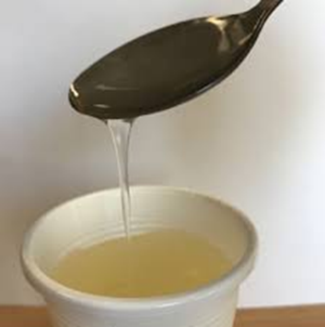
Density is the mass per unit volume. It affects how the fluids move during swallowing processes.
(Source: NHS)
Yield stress is the force required to break down the internal structure of the fluid in order for it to flow. All thickened liquids have a yield stress that must be overcome to allow the liquid to flow.Viscosity, density and yield stress should be considered when designing and preparing thickened fluids for dysphagia conditions.
Textural properties and dysphagia
-
Food texture is the branch of physics that relates to solid or viscoelastic foods.
-
Some textural attributes are: hardness, softness, cohesiveness, stickiness, springiness, adhesiveness, toughness, extensibility,.....
-
Textural parameters are very important when preparing food for dysphagia patients.
-
Food texture adaptation in dysphagia is achieved through particle size modification with or without incorporation of thickeners.
-
Textural properties can be measured by specific equipment named texture analysers.