Unit 1 - Dysphagia
Lesson 1.2. Detection, diagnosis and treatment
1.2.2.2 Clinical examination
Clinical examination is a set of procedures performed by a trained speech-language pathologist, whose purpose is to obtain further clinical information that confirms the diagnostic orientation provided by the medical history.
Clinical information: data of any form, type or kind that allows acquiring or extending knowledge about the physical and health condition of a person to preserve, care for, improve or recover it.
The main objective of clinical examination in dysphagia is to provide the clinician information on the existing deficits, neuromuscular processes involved in swallowing and their modifications. In this way, hypotheses about the pathophysiological mechanisms responsible for the disorder can be put forward and select the optimal diagnostic and treatment techniques.
Main clinical explorations:
-
Face, trunk and cervical observation. Paying attention to facial gestures, neck, posture and head position.
-
Oral cavity exploration. Observation of the oral anatomy and physiology: ability to open the mouth, labial, lingual movements in all axes of space, mandibular and cheek movements active and against resistance. Presence or accumulation of residues or saliva, alteration of the chewing capacity, state of teeth and any alteration of the anatomy or physiology of the same.
-
Pharyngolaryngeal motor and sensory examination. Assessment of laryngeal mobility, presence of secretions, glottic function and voluntary cough. The latter is a sign of laryngeal protection against aspiration. People with cervical tracheostomy scar will be explored to ensure that there are no adhesions that limit the mobility of the larynx.
-
Cognitive status assessment. Evaluation of limb mobility, posture, tone, coordination, osteotendinous reflexes and superficial and deep sensitivity. The detection of abnormal movements, dystonia or archaic reflexes (sucking and biting) allows planning the most appropriate guidelines for treatment based on their active collaboration and understanding.
-
Neurological examination of the cranial nerves. Nerves containing motor and sensory fibers. They control the symmetry of the lips, face, protrusion, mobility and strength of the tongue, symmetry of the uvula and palate, oral and oropharyngeal sensitivity, the ability to manage secretions and the ability to cough voluntarily. The assessment of these movements will be done by verbal request, repetition or performance of buccolinguofacial praxias.
-
Exploration of gag reflex, swallowing and cough reflex. Provocation of gagging, swallowing and coughing to assess responsiveness to a complication during feeding, ensuring the safety and efficacy of the process.
-
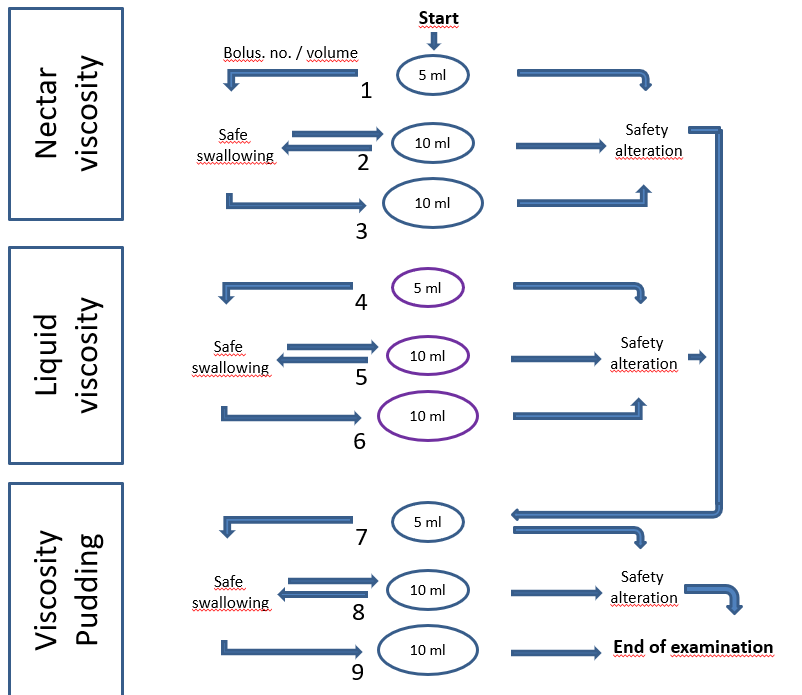
Exploration of swallowing by phases. It aims to locate alterations in the movements and sensitivities of the structures involved in each phase of the swallowing process (oral preparatory phase, oral propulsive phase and pharyngeal phase). Different methods have been developed based on the administration of boluses of different viscosity and volume. These tests can only be recommended and performed by qualified and experienced healthcare personnel, mainly doctors, speech therapists and nurses. The most famous and widely used is the MECV-V because it is a safe and validated method, although there exists others.
MECV-V (clinical examination method volume-viscosity)
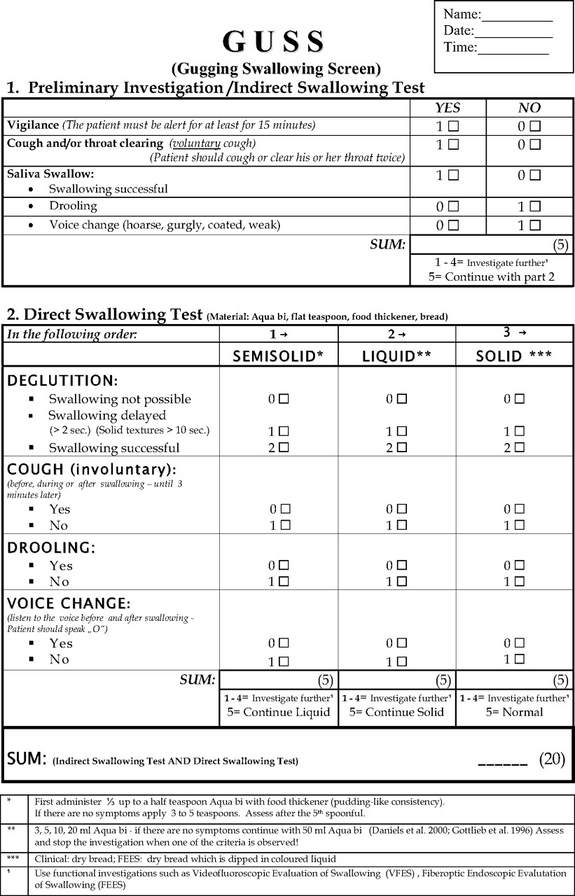
GUSS (Gugging Swallowing
Screen)