Unit 1 - Dysphagia
Lesson 1.2. Detection, diagnosis and treatment
1.2.2.1 Medical history
Elaborating a meticulous clinical history allows us to determine, in
80% of cases, the location of the problem, differentiating whether it
is an oropharyngeal or esophageal dysphagia, it causes and establish
correct diagnosis. The performance of a differential diagnosis makes
it possible to differentiate dysphagia from other clinical pictures
such as Presbyphagia or Odynophagia. 
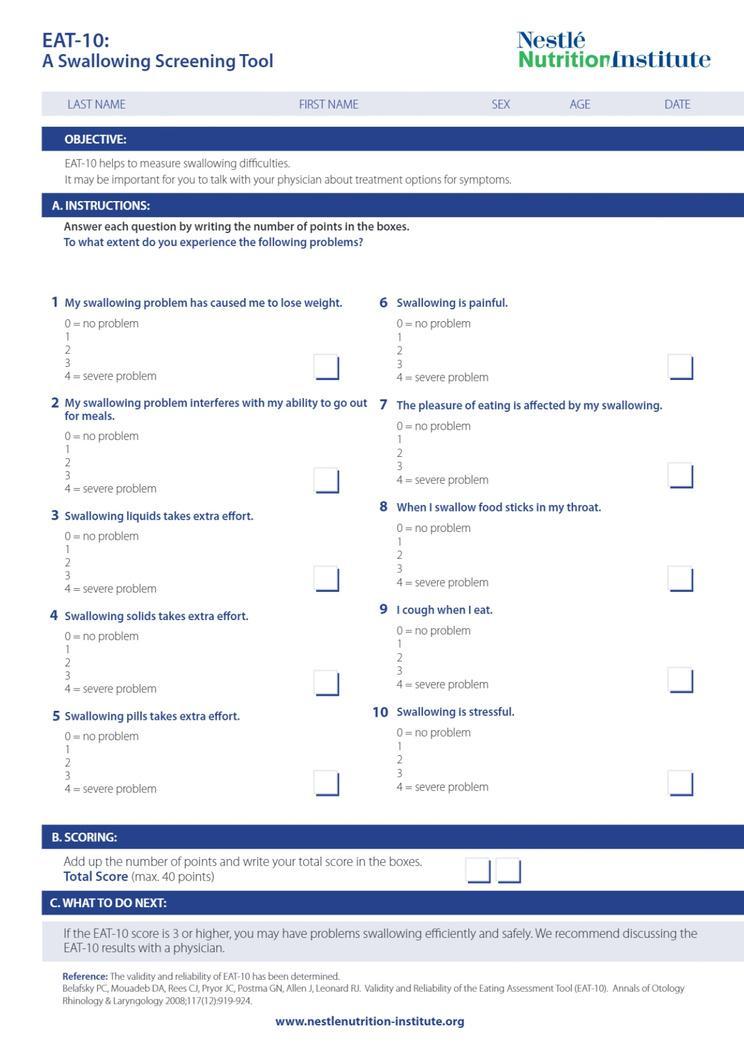
Questionnaires such as EAT-10 (Eating Assessment Tool) are screening tests to identify those individuals at increased risk for clinical signs of dysphagia. They should be thoroughly evaluated and results should be included in medical history.
EAT-10 (Eating Assessment Tool) is a simple and internationally validated questionnaire. It consists of 10 questions to be answered on a scale of values from 0 (no problem) to 4 (serious problem). This tool can be completed by the patient and/or caregiver and is quick to complete (3-5 minutes). If the score is higher than 3, it indicates that the person may have oropharyngeal dysfunction. It is not a valid instrument for the diagnosis of dysphagia.
(Source: obtained from Canva Pro)