Unit 1 - Dysphagia
Lesson 1.1 Dysphagia
1.1.1 Swallowing
Swallowing is a complex process. Some 50 pairs of muscles and many nerves work to receive food, drink, medicines or saliva, prepare it and move it from the mouth to the stomach.
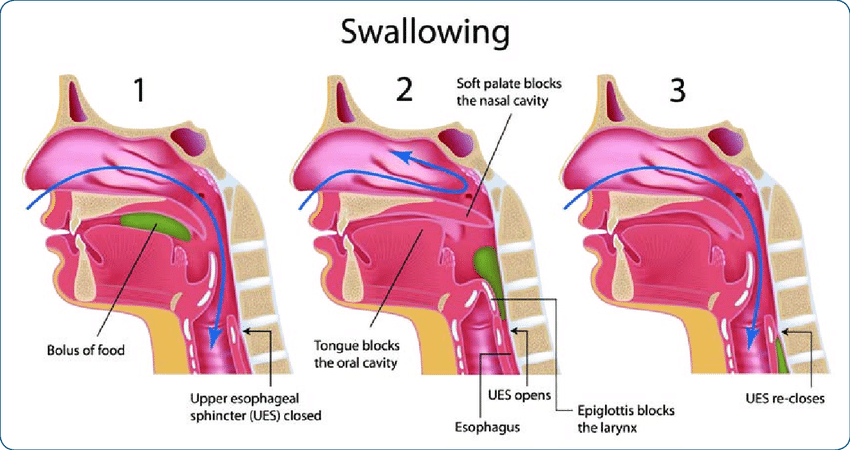
There are three swallowing phases:
-
Oral phase: Voluntary movement of the bolus from the oral cavity into the oropharynx.
-
Pharyngeal phase: Involuntary movement of the bolus from the oropharynx into the esophagus.
-
Esophageal phase: Involuntary movement of the bolus through the esophagus and into the stomach.
(Source: https://www.istockphoto.com)
The oral phase of swallowing is the first stage of deglutition and it is a voluntary process. It is also commonly known as the buccal phase. It involves the contraction of the tongue to push the bolus up against the soft palate and then posteriorly into the oropharynx by both the tongue and the soft palate.
Unlike the oral phase, the pharyngeal phase is an involuntary process. First, the tongue is blocking the oral cavity. Then, the nasopharynx is sealed off from the oropharynx and laryngopharynx by elevation of the soft palate and its uvula. The pharynx will then receive the bolus after shortening and widening, at the same time, the larynx will elevate. Finally, the upper esophageal sphincter relaxes and opens, allowing food to enter the esophagus. During this phase, respiration is inhibited, and the epiglottis blocks off the upper airway to prevent the food bolus and liquids from entering the airway and being inhaled. If food does enter the airway, the coughing reflex is triggered. This can happen if someone talks or inhales while swallowing.
The final stage of deglutition is the esophageal phase, which is involuntary. The food bolus is forced inferiorly from the pharynx into the esophagus. Muscle contraction creates a peristaltic ridge. Once the food bolus has fully entered the esophagus, the upper esophageal sphincter will contract and close again. The food bolus then moves through the esophagus via peristalsis, the sequential contractions of adjacent smooth muscle to propel food in one direction. Gravity also aids in the movement of food to the stomach.