Unit 2 - Care and nutrition (e-book)
Lesson 2.1. Nursing and feeding techniques and equipment
2.1.7. Oral care
Why is oral care important?
Oral care is essential for everyone to maintain clean and healthy teeth and mouths. However, people with dysphagia (difficulty with chewing and swallowing) are at a greater risk of poor oral hygiene and health.
This is because they are at risk of food and drink pooling in the mouth and inhaling food, drink and saliva into the lungs (aspiration) when swallowing. Aspiration of the harmful bacteria that develops in unclean mouths can lead to life threatening respiratory difficulties and chest infections known as aspiration pneumonia.
(Source: https://www.freepik.com)
How often should oral care be performed?
Oral care should be performed at least twice a day morning and night, but people with dysphagia may need extra oral care before and after meals. This is to minimise their risk of aspirating harmful bacteria and any fluid that may be pooling in the mouth.
It is also important to remove any food debris from the teeth and mouth after meals that could pose a choking risk. Debris also provides a breeding ground for bacteria and the development of plaque that leads to tooth and gum disease.
Who should perform oral care?
Wherever possible the person should be encouraged to brush their own teeth. This may be difficult for people who find it difficult to hold a toothbrush. There are toothbrushes which have large handles and angled heads to make them easier to use.
Alternatively, you may need special handgrips and other adaptations which can be fitted to manual toothbrushes to make them easier to hold. Electric toothbrushes with oscillating heads are very effective at providing a large amount of cleaning action with very little movement needed from the user, although you do need to position the brush correctly.
What products should I use?
a dry small headed soft to medium bristled toothbrush;
a small pea-sized amount of toothpaste on a dry toothbrush.

(Source: pixabay.com)
How to perform oral care for those who need help?
If the person requires assistance to perform oral care you should:
stand or sit behind them because it helps to support their head and means your hands are in the most appropriate position to brush their teeth
Tilt the persons head forward slightly to reduce their risk of aspirating on the toothpaste and debris brushed from their teeth
Aim to lay them on their side with their head on a pillow and a towel covering the pillow if the person is unable to sit upright
do not wet the toothbrush which will keep foaming to a minimum.
What if the person is nil by mouth (NBM)?
Some people with severe dysphagia are unable to be fed orally and are fed via a feeding tube. It is important that their teeth and mouths are kept clean and healthy.
Sometimes people who are NBM can form calculus more quickly and it may be difficult to remove. Good tooth brushing will prevent this.
They may develop aversion or ‘sensory defensiveness’ to oral care. This can be avoided with very gradually increased amounts of regular oral care with a soft toothbrush and mild or unflavoured toothpaste. People who are nil by mouth frequently suffer from dry mouth.
What if the person suffers from dry mouth?
Oral care is especially important for individuals who suffer from dry mouth as they are at greater risk of dental decay and gum disease. A dry mouth is very uncomfortable and also makes chewing and swallowing more difficult.
If able the person should be encouraged to take frequent sips of water. There are also a number of saliva substitute gels and sprays designed to provide moisture and comfort.
What if the person wears dentures?
Oral care is equally important and night, and rinsed after eating to remove any debris. When removed, all surfaces of the people with no natural teeth to keep the mouth clean, healthy and to promote saliva flow. Dentures should be removed at night to allow the gums to rest. They should be cleaned twice a day, morning dentures should be brushed with a toothbrush or denture brush to remove any plaque and debris.
Dentures can be brushed with warm soapy water; a denture cleanser will help to remove stubborn stains. Ensure you clean dentures over a sink filled with water in case you accidentally drop them. When not in the mouth they should be left to soak in cold water to prevent them warping and cracking.
Oral hygiene recommendations based on dysphagia severity and common speech-language pathology interventions
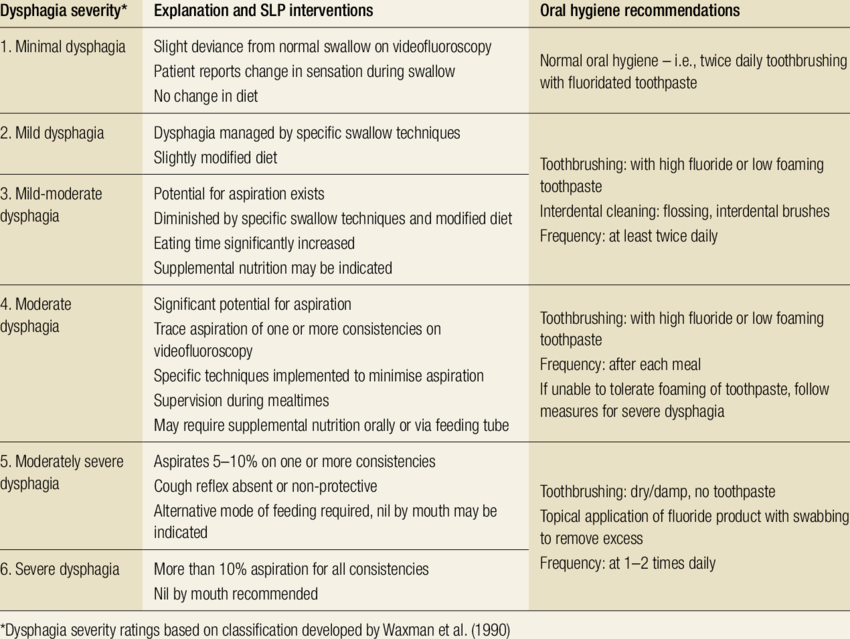
Obtained from: Lim M. Basic oral care for patients with dysphagia - A Special Needs Dentistry perspective. JCPSLP. 2018; 20(3):142-9.