Module 5.3 Reading
Improve student learning with an appropriate orientation of curricular actions

Introduction
The integration of education for sustainability is essential to involve students in the construction of a new culture of sustainability and to generate a collective transformation.
In this section we propose to know how teachers and managers can incorporate in the educational projects the concepts, procedures and attitudes that promote the achievement of basic skills in the field of environmental education.
Importance of integrating environmental education transversally in the school curriculum
That our students understand in depth the reality that surrounds them and the environmental challenges that lie ahead, enables them to make decisions and act more responsibly in order to become agents of the transformation we want for our school and our planet
Education for sustainability aims to engage people in the critical reflection of their current actions and lifestyles, so that they can be more capable of make decisions and act for a more sustainable world[1].
Given that sustainability is not a separate branch of science, but an interdisciplinary field of study, environmental education projects are a great opportunity to activate multidisciplinary learning within the schools that involve the coordination and connection of content from various subjects. For this reason, it is necessary for the entire teaching team to know the key concepts of education for sustainability and for the programming of each subject to be able to include projects and activities that refer to them.
Key competences in curriculum design for environmental education
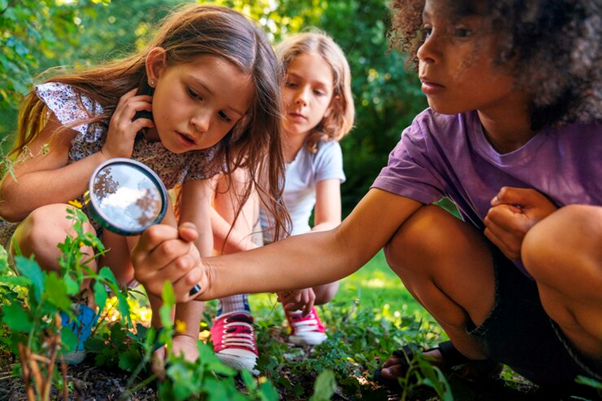
In accordance with the Recommendation of the Council of the European Union of May 22nd, 2018 regarding key competences for lifelong learning, it is appropriate that when programming a subject or designing a project we take into account what the competences are basics related to environmental education.
According to the DeSeCo (Definition and Selection of Competencies) of the OECD, competence is understood as “the ability to respond to complex demands and perform various tasks in an appropriate way. It involves a combination of practical skills, knowledge, motivation, ethical values, attitudes, emotions and other social and behavioral components that are mobilized together to achieve effective action”[1]
These competencies related to environmental education can be summarized in the five following aspects: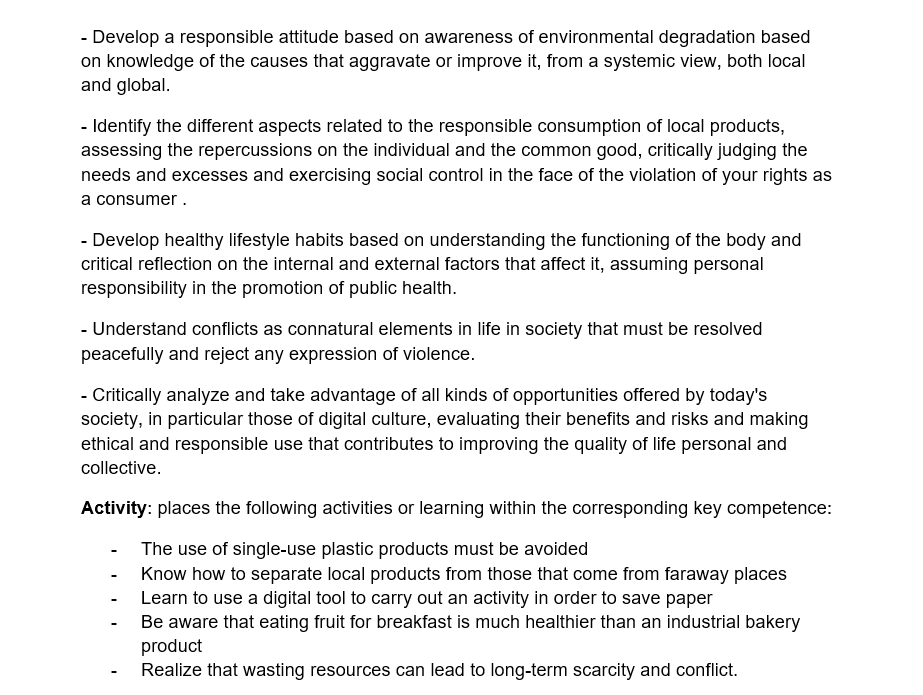
What must be taken into account when integrating environmental education into the curriculum design itself?
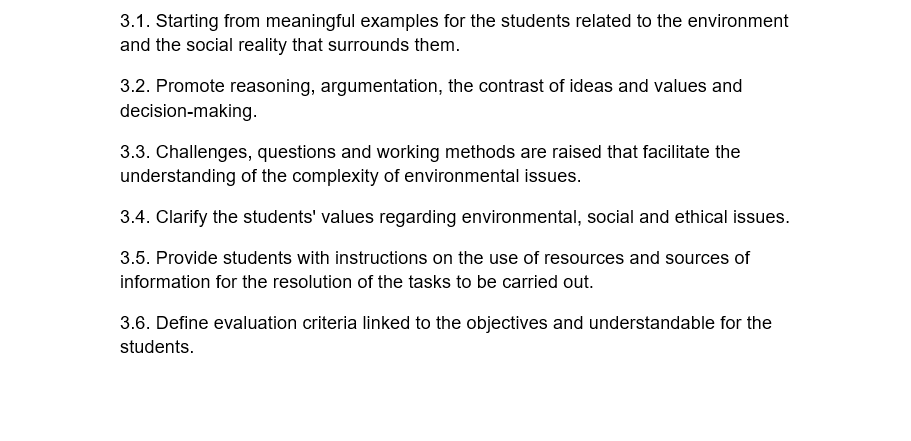
Interdisciplinary projects in environmental education
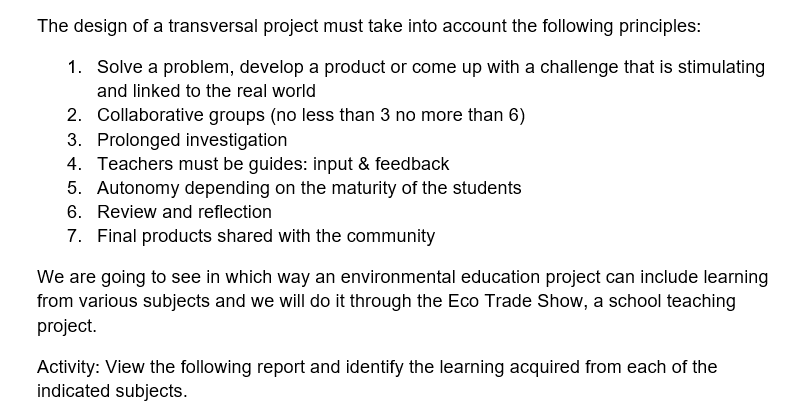
Publicly expose your product to visitors at the fair
Design a mural explaining your product
Measure energy savings