Module 4.2 Reading
Human beings, through their greenhouse gas emissions, have introduced a disturbance into the atmospheric system. A bit like a game of dominoes, once you touch one part of a system, all the other elements of the system are disturbed. This is what is currently happening with our Earth system.
The rise in temperature due to the emission of greenhouse gases of human origin is causing numerous consequences for our planet but also for us, humans.
The first consequence of this rise in temperature, which is already visible at this moment, is the melting of the ice sheets and the sea ice in the polar regions, but also the mountain glaciers elsewhere in the world.
Let's review each of these 3 elements
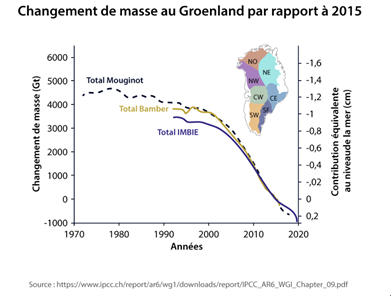
Ice sheets are vast glacial expanses that rest on a rocky base and can reach 3 to 4 km of ice thickness in their center. There are two of them, one in the northern hemisphere, the Greenland ice sheet, and the other in the southern hemisphere, the Antarctic ice sheet. These ice sheets are formed by the gradual accumulation of snow precipitation which, over the years, compacts under its own weight, forming ice. But this ice will melt because of the rise in temperature. Here is the graph of the mass change of the Greenland ice sheet where we can see since the 1990s that this ice sheet has lost more than 4000 Gt of ice. But this unit is not very meaningful, so to simplify, we will speak in terms of sea level rise equivalent. Yes, this water stored in the form of ice on land, once melted, will join the ocean and will contribute in the rise of sea level. So let's calculate this loss of ice as an equivalent contribution to the rise in sea level. For Greenland, we can read that in 20 years, the melting of its ice has contributed to a rise in sea level of + 1 cm.
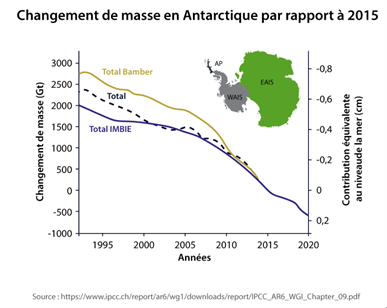
Let's do exactly the same exercise for the Antarctic ice sheet and we get this figure. We can see that the loss of mass is also continuous since the 1990s. However, in absolute terms, it is less than the loss of mass from the Greenland ice sheet: in 20 years, Antarctica has lost about 2500 Gt of ice and has therefore participated to a 6 mm increase in sea level. Let's be careful here that the climate, the geographical configuration and the melting processes are very different between Antarctica and Greenland.\
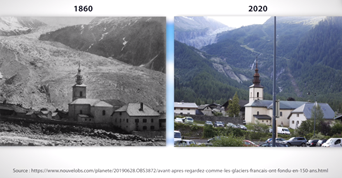
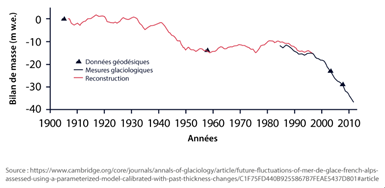
There are not only the ice sheets that are inexorably melting. There are is a very large majority of mountain glaciers, the most emblematic of which for Europeans is the “Mer de Glace” in Chamonix. These before and after pictures show how much the glacier has been retreating towards the summits for more than a century.
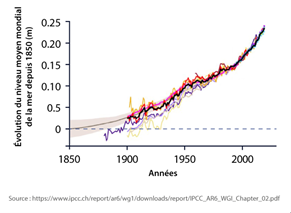
All these mountain or ice sheets form a mass of water stored on the different continents, but when this ice melts, it runs off to the ocean and then participating to the increase of the sea level. And this is what we are exactly observing! This graph shows that the sea level has increased by almost 25cm since 1850.
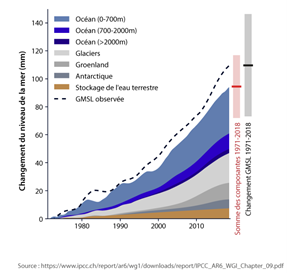
However, it is not only the inflow of water due to melting ice that contributes to the rise in sea level. There is also what is called the "thermal expansion of the oceans". To explain this simply, the ocean, like any other material, expands as soon as its temperature increases. When it warms up, it occupies a larger volume than when it is colder. Thus under the action of global warming, the ocean absorbs a large part of the energy available in the atmosphere and stores this energy in the surface, middle and deep ocean. These three parts can be found on the blue slices of this figure, which represents the share of each element participating in the observed rise of the sea level. The melting of ice is represented in the shaded areas, and, to a lesser extent, the water stored on land or underground that migrates to the oceans is represented in orange. These 3 components together contribute to the rise in sea level. Due to uncertainty, it is not clear which of thermal expansion or ice melt is more important than the other, but one thing is certain: global warming is the cause of both.
As a direct consequence of rising sea levels, coastlines around the world, and even some islands like the Maldives, are being covered by water. As territories disappear under the sea, humans are forced to migrate to other areas. This can cause, in the worst case, tensions between populations or geopolitical problems related to access to basic resources such as food and drinking water.
Let's go back to the sea and mainly to the North and South poles
On these cold seas floats ice, which is called sea ice. This sea ice forms in winter and melts in summer. However, from year to year, the sea ice extent is getting smaller and smaller in the Arctic regions. In some places, it even disappears completely during the summer as shown in this graph. However, it does not contribute to the sea level rise because this ice is already floating on the surface of the sea. It is the same principle when an ice cube in a glass melts, the level of the glass does not increase.
On the other hand, one of the consequences of this melting of the sear ice is that the ocean is becoming open water and dark. What is the problem? Well, by going from a white ice surface when it is covered with ice to a dark surface when it is composed of liquid water, the radiation absorbed by this surface increases. It is the same principle when you wear a white or black t-shirt in summer: your black t-shirt absorbs more energy and therefore you are warmer than with a white t-shirt which reflects energy. If we go back to our melted sea ice giving place to open water, the energy reflected by this change of surface decreases and therefore the energy absorbed by the surface becomes much larger, which amplifies locally the consequences of global warming.
The Arctic region is warming much faster than the rest of the world due to this positive feedback loop: the warmer is, the more it melts, the lower the surface albedo, the more energy the surfaces absorb and the warmer it is, the more it melts, etc.
Beyond the
visible ice, the continental polar lands are frozen all year round to a greater
or lesser depth depending on the region. These frozen lands are called
permafrost.
But as for the ice, this permafrost is also impacted by global warming and has been melting for decades.
The melting of the permafrost has two dramatic consequences: on the one hand, the ground becomes muddy as it thaws and thus destroys all existing buildings, whether they are houses, roads or industrial infrastructures; on the other hand, this permafrost contains an enormous stock of carbon in the form of methane. As this carbon thaws, it is released into the atmosphere, increasing the concentration of greenhouse gases and thus amplifying global warming. Here again, we are faced with a positive feedback loop where the permafrost, by melting, increases the atmospheric concentration of greenhouse gases which intensifies global warming which increases the melting of the permafrost etc.
These consequences of global warming are already visible at the moment, we do not have to wait until 2050 or 2100 to see them, they are already there in front of our eyes. We will see in a next video the consequences to come for the next decades in the world but also in Europe: