Module 5.2 Reading
How to motivate and involve students in the change process

Introduction
Involving the entire educational community in a common project is a complex task that requires planning and persistence. Let's see what steps need to be taken to involve our students in the transition to a more sustainable educational center.
Involvement of the entire school community
The first step to motivate and involve our students in the change process is for the teaching team to be fully identified with the project. Only if we as adults show our commitment to building a more sustainable society will we get our students involved.
The steps to follow to carry out this transformation are:
A. Show the opportunity and the need to carry out the change towards sustainability
The first step to convince our teaching team to carry out a transformation towards sustainability is to create the need to do so, analyzing the needs and shortcomings we perceive in sustainability in our school.
To carry out this first step you need to create a transversal commission of managers, teachers and non-teachers that is the engine of change.
B. Visualizing the change together: reimagining our school.
Once we are determined to make ours a more sustainable school, we need to determine some objectives:where we want to go. Imagining that these changes have already taken place will help us find meaning in our actions and will mark the path of the change process.
It is necessary that as many people as possible can contribute their ideas so that everyone feels responsible.
C. Empower and train teachers to carry out this change
To make these ideas come true, the people who have to carry them out need to feel empowered and empowered. It is necessary to allow the teaching staff to make and decide and, above all, that they are trained and accompanied to carry out the transformation. This is a priority task for management teams, which follow up, remove obstacles and organize actions according to priorities and objectives.
D. Evaluation and consolidation
It is necessary to establish a regular evaluation mechanism that assesses the achievement of the objectives that have been proposed. At this point it is particularly important to celebrate successes and share them with the rest of the educational community, recognizing the efforts of the people who have made it possible.
To maintain this dynamic of progress and improvement, it is necessary to review the objectives and update them in accordance with the new needs that appear: a task that must be coordinated by the transversal committee that periodically meets to carry out this analysis.
Activity: you will find below a series of actions to involve our entire educational community in the change process. It is about placing each action in its corresponding section:
|
Show the opportunity and the need to carry out the change towards sustainability |
- Create a transversal commission to lead the change (1) - Draw up a form to ask the teaching team about priorities (2) - Share with the educational community the improvements that have been carried out. (4) - Offer a course on sustainability in the classroom (3) - Determine the indicators to evaluate the changes (2) - Specify the periodicity of the meeting of the transversal commission (4) - Determine the objectives for improving the sustainability of the center. (2) - Recognize the work of the people involved in a successful action. (4) |
|
Visualizing the change together: reimagining our center |
|
|
Empower and train teachers to carry out this change |
|
|
Evaluation and consolidation |
Become aware of the ecological impact of our consumption
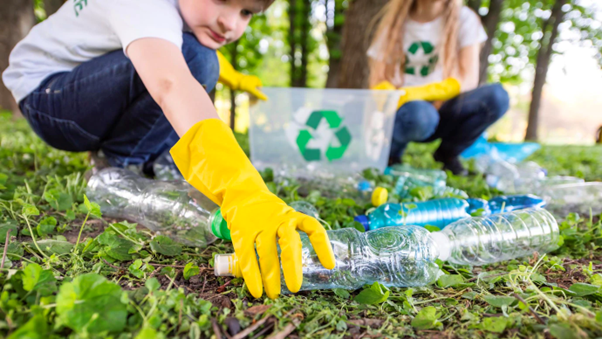
To get our students involved, it is essential to make them aware of the impact their consumption has on the planet so that they can discover ways to make more responsible use of resources and avoid waste.
Through the ecological footprint calculator (Footprint calculator) you can calculate the space a person needs to obtain the resources they consume and assimilate waste and CO emissions2 that generates
Calculating our own ecological footprint helps us to be aware of the impact our lifestyle has on the planet and also helps us to reflect on those things we can do to lead a more sustainable lifestyle.
Scientific resource: Footprint Calculator https://www.footprintcalculator.org/home/en
Make students the engine of change
It is important that our students realize that they can play a significant role in the transformation not only of our school but also of the entire world.
Although the decisions that will determine the future of our planet are in the hands of adults, it will be children and young people who will pay the consequences. That is why the voice and involvement of the youngest hits the conscience of adults and pushes them to take the necessary measures to preserve the planet. Greta Thunberg has become a voice heard around the planet and her speech in front of world leaders at the 2019 climate summit is a truly inspiring example.
Video:
Essential agreements
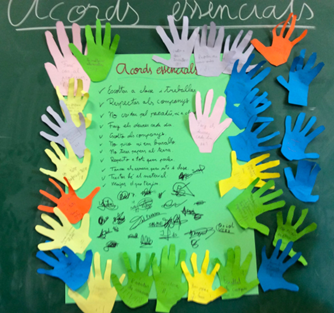
Once our students are aware of the environmental challenges facing our planet and discover their role, it is time for commitment. Words are not enough, we need concrete actions that have a positive impact on our environment. The understanding of environmental problems can awaken in children the necessary motivation to introduce significant changes in their habits and personal lifestyles, which is why we suggest that you carry out some essential agreements with your students.
The Essential Agreements are that set of rules that are agreed upon with the whole class and that are internalized by the students themselves, they are never imposed but it is the students themselves who undertake to comply with them.
Once agreed, the essential agreements are embodied in a visible and accessible place in the class where the boys and girls can remember or be aware of what they have agreed.
This video explains what they are and how to build them:
Let's create a more sustainable classroom together

Regardless of the role you have in the school or the material resources you have, you can take the initiative to make yours a more ecological class with the involvement of your students. Here are some ideas that can help you:
5.1. Spaces free of plastic and aluminum foil
If a primary school student consumes an aluminum container or wrapper a day, in one school year he would accumulate 180 plastic containers and aluminum foil.
5.2. Reduce and reuse in the classroom
It is good to make students and their families aware that the material from other years can be reused: there is no need to buy a new backpack every year or buy new desk material if what we have still works.
5.3. Take advantage of natural light
Natural light not only increases productivity and improves mood, it also reduces our school’s electricity consumption.
5.4. Minimize the use of paper
Encouraging to present works digitally or reusing paper that has already been used for one side.
5.5. Save energy
To protect us from the heat, open the windows to allow natural ventilation and close them early in the morning and lower the blinds on the windows that receive direct sunlight to keep our classroom cool.
To keep classrooms warm in winter, avoid drafts and renew the air just a few minutes at the end of each class.
Disconnect all devices at the end of the school day.
5.6. Monitor progress and celebrate improvements
Make the results of your efforts visible and make them visible to students.
The best way to involve our students is to position them as protagonists who take on the challenge of contributing to solving real environmental problems such as those you can raise to make a more sustainable classroom.