Module 7.3: Reading
7.3 Education for sustainability in Europe

7.3.1. Introduction
Education and training must act to respond to this planetary crisis. For this reason, the European Commission supports the EU Member States to provide teachers and students with the necessary knowledge for a green economy and society, integrating sustainability in teaching and learning.
The Commission sets out how sustainability can be integrated into all aspects of education, calls on Member States to include in their education programs providing students with opportunities to learn about the climate crisis and acquire the necessary skills to face it.
7.3.2. Education for Sustainability in Europe
Although it seems a recent phenomenon, environmental education has a long tradition in Europe. In the middle of the last century, outdoor education was promoted in several European cities. In the case of Catalonia, before the Spanish Civil War (1936-1939), the pedagogue Rosa Sensat was the main promoter of the Escola del Bosc in Montjuïc (Barcelona). Although there were no issues around sustainability, the main objective of these schools was to strengthen the children's health, as Sensat realized the intellectual, physical and social development it provided.
At the beginning of the new millennium, most states in Europe provided environmental education to their students, either as a specific subject or as part of the curriculum of certain subjects. The main areas where environmental education was addressed were geography and science, but it was also included in other areas, such as, for example, technology and social sciences (Stokes et al., 2001)
As we already said at the beginning of this module, currently the European Union has proposed that education for sustainability be included in the educational curricula of all member countries in all educational programs to develop key competences around sustainability. Let's see in the next section what they are and how these competences are configured.
Activity: Classify the following learning into knowledge and competences.
- Form your own criteria about environmental problems to develop critical thinking.
- Elements and factors that condition the climate and the impact of human activities.
- Climate risks and catastrophes in the present, past and future. Explain the interrelationships between the elements of the geographical space, to manage human activities in the territory with sustainability criteria.
- Participate in the classroom in a reflective and responsible manner.
- The importance of the conservation of ecosystems, biodiversity and the implementation of a sustainable development model.
- Recognize the need to adopt eco-social commitments to meet the Sustainable Development Goals.
Solutions:
Knowledge (to know) | skills |
2, 3, 5 | 1, 4, 6 |
7.3.3. Competency education for sustainability: Green Comp

One of the decisions established in the European Green Deal is the development of a European framework of competences in sustainability, which is called Green Comp.
We understand by "competence" the ability to respond to complex demands and perform various tasks in an appropriate way. It involves a combination of practical skills, knowledge, motivation, ethical values, attitudes, emotions and other social and behavioral components that are mobilized together to achieve effective action" (SeDeCo, 2003).
The objective of the Green Comp is to provide common ground to students and educators on what sustainability as a competency entails. The report is designed to support education and training programs for lifelong learning. This was developed in 2021 in close collaboration with experts across Europe and internationally, including research institutions, youth representatives, educators, policy makers and NGOs.
According to this sustainability competence framework, learning for environmental sustainability aims to foster a sustainability mindset from childhood to adulthood. So, students have knowledge and skills that help them become agents of change and contribute to shaping the future of the planet.
GreenComp consists of four "areas" of competence that correspond to the definition of sustainability; and the twelve "competencies" that, considered together, constitute the pillars of sustainability competence for all people. Each competence is accompanied by a descriptor, which represents the main characteristics.
So, the 12 skills are organized in four areas:
- Embody the values of sustainability, including the competencies:
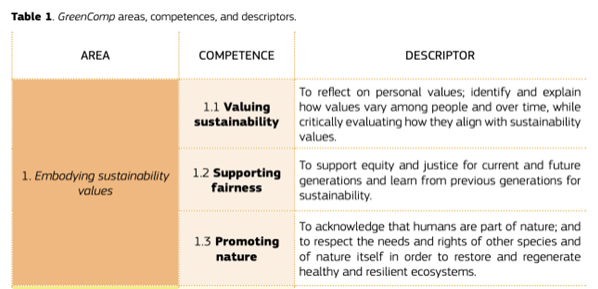
- Valuing sustainability: Reflecting on personal values; identify and explain how values vary between people and over time, while critically evaluating how values align with sustainability.
- Supporting justice: Support equity and justice for the present and future and learn from previous generations.
- Promoting nature: Recognize that humans are part of nature; and respect the needs and rights of other species and nature itself to restore and regenerate resilient ecosystems.
- Embrace complexity in sustainability, including competencies:
- Systems thinking: To address a sustainability problem from all sides; consider time, space and context, understand how elements interact within systems
- Critical thinking: To evaluate information and arguments, identify assumptions, challenge the status quo and reflect on how personal, social and cultural backgrounds should be known.
- Framing problem: To formulate the current challenges as a sustainability problem in terms of difficulty, people involved, time and geographical scope, in order to prevent problems and mitigate and adapt to already existing problems.
- To see sustainable futures, including skills:
- Literacy of futures: Conceiving alternative sustainable futures by imagining and developing alternative scenarios and identifying the necessary steps to achieve a sustainable future.
- Adaptability: Manage challenges and complex situations in sustainability situations and related decisions for the future in the face of uncertainty, ambiguity and risk.
- Exploratory thinking: Adopting a relational way of thinking by exploring and linking different disciplines, using creativity and experimentation with new ideas or methods.
- Act for sustainability, including the skills:
- Political agency: Responsibility for unsustainable behavior and effective political demands for sustainability.
- Collective action: Acting for change in collaboration with others.
- Individual initiative: Identify your own sustainability potential and actively contribute to improving the perspectives of the community and the planet.
In this image, we can appreciate the first area with the 3 competencies and their corresponding descriptors.
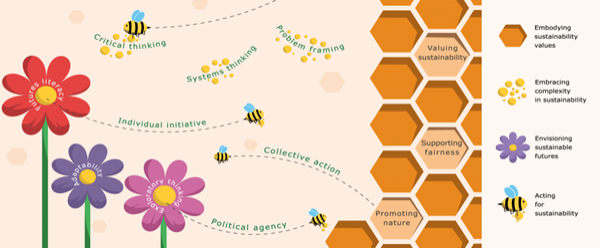
The bees represent the related competencies in the field "act in favor of sustainability": political action, collective action and individual initiative. Bees act as independent agents and as a collective organism.
The flowers represent the competencies related to the field "envision sustainable futures": the ability to project the future, adaptability and exploratory thinking. Flowers produce fruit and these produce seeds so that life can continue.
The beehive represents the competencies related to the field of "embody sustainability values": appreciation of sustainability, support of nature. Therefore, it protects and maintains the bees.
The pollen and nectar represent the competencies related to the field of "assume the complexity of sustainability": systemic thinking, critical thinking and contextualization of problems. Pollen and nectar attract bees to flowers and they transport the pollen from flower to flower as they collect food for their swarm. Complex does not mean complicated, but rather that many different interrelated elements are involved.
Finally, we highlight several skills that we find within this sustainable framework, such as the appreciation of sustainability, support for equanimity, promotion of nature, systemic thinking, critical thinking, collective action, political action, etc.
Activity: classify the following competencies within their corresponding field:
- Manage transitions and challenges in complex sustainability situations and make decisions related to the future in the face of uncertainty, ambiguity and risk.
- Recognize that human beings are part of nature and respect the needs and rights of other species and nature itself in order to restore and regenerate healthy and resilient ecosystems
- Act in favor of change in collaboration with other agents
- Evaluate information and arguments, identify assumptions, question the status quo and reflect on how personal, social and cultural contexts influence thinking and conclusions
act in favor of sustainability | envision sustainable futures | embody sustainability values | assume the complexity of sustainability |
2) | 4) | 1) | 3) |
Sources and resources: